



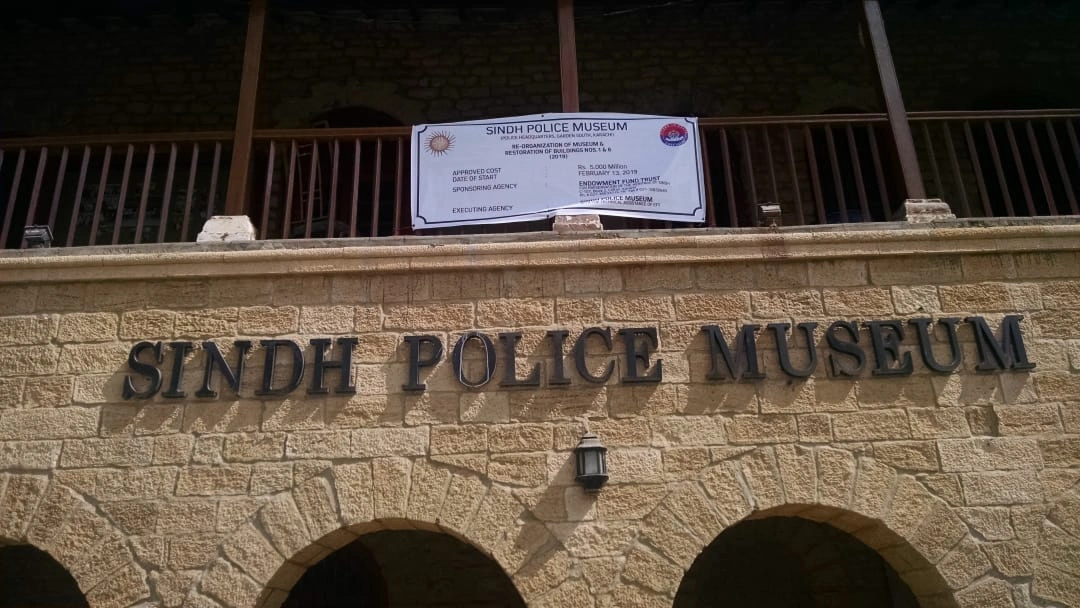
Board approval: 20 March 2018 \ Rs. 5 million
The Sindh Police Museum was designed by Charles Napier in 1840, in a British colonial style derived from barrack architecture that arrived in Sindh in the mid-19th century. The main vision for the museum was to preserve the legacy of Sindh Police and highlight its evolution since 1843, to collect and preserve police heritage including weapons, photographs, awards and medals, case files, and newspaper cuttings, and to commemorate those officers who served the province and laid down their lives in the line of duty. The museum is part of a complex that consists of five heritage buildings centred around a courtyard. The entire complex was constructed from yellow Gizri stone, which was the local stone available during that time. There are two main components of this project: the conservation of the building, and the reorganisation of the museum itself. Previous restoration attempts involved raising the floor level and resolving structural cracks and fissures using cement. Unsympathetic to the historic fabric of the building, these activities and materials encouraged moisture and rising damp into the walls. Beginning in 2019, EFT’s efforts thus far have included lime pointing and conservation of mouldings on top of the doors and windows. Major work had commenced on the woodwork of the building, which had been damaged severely by rot and termites. Wooden features include doors, windows, rafters, fanlights and a staircase. This project is employing members of the traditional carpentry community of Shikarpur, some of whom have been training with EFT for the last 7 years. Designs for the museum and cataloguing of artefacts are in progress. The work is expected to be completed by June 2021.